


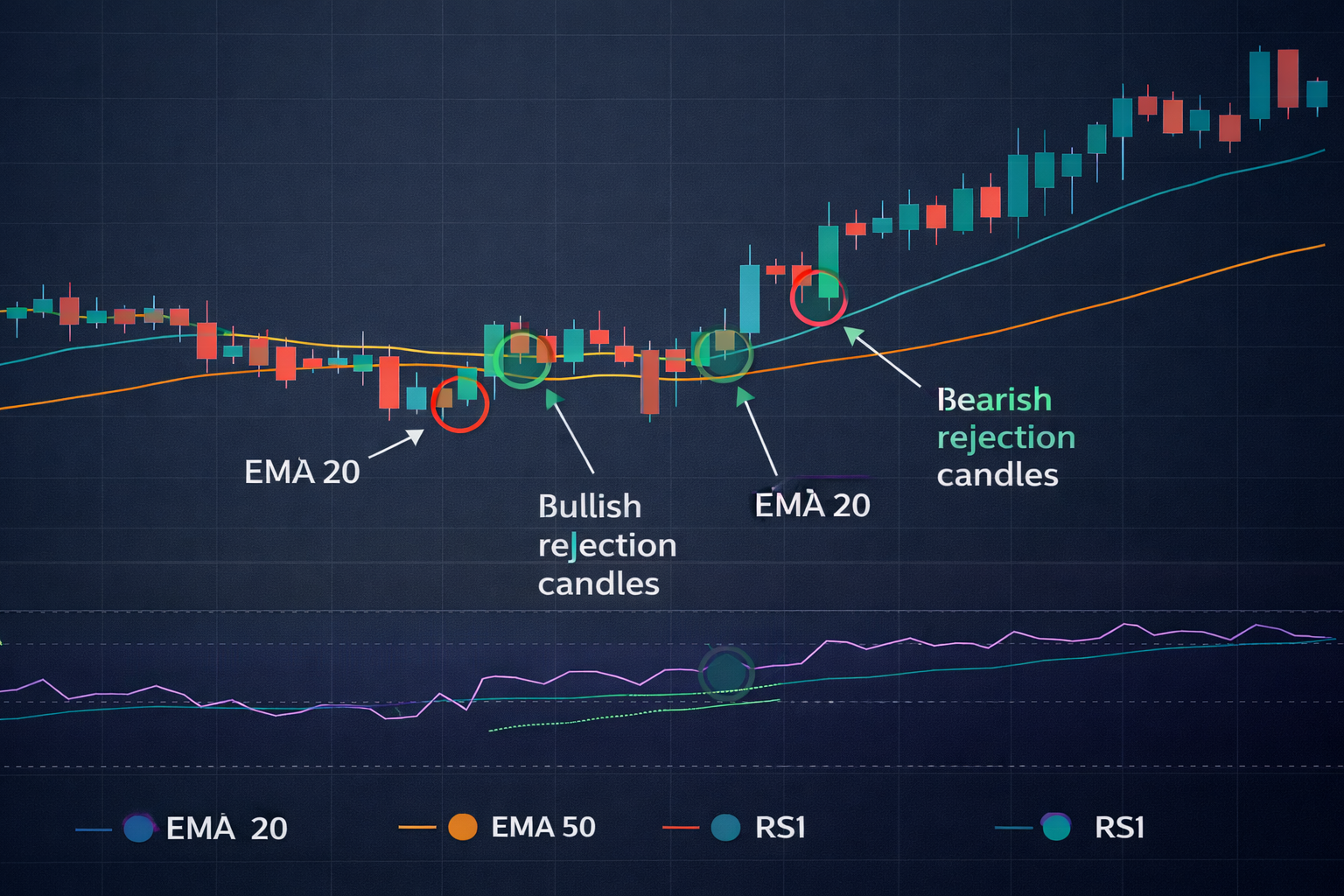
Binary trading on the 1-minute chart is extremely fast and risky if done without a proper system. Most traders lose money because they try to predict the next candle, which is not how professional trading works.
In this guide, you will learn a probability-based 1-minute binary trading strategy using EMA 20, EMA 50, and RSI. This strategy focuses on trend continuation and rejection candles, not guessing candle colors.
Important: This strategy does not guarantee wins. It is designed to improve decision-making and trade filtering.
What This Strategy Is (And What It Is Not)
What it is:
-
A trend-following strategy
-
Works on 1-minute charts
-
Uses EMA pullbacks and rejection wicks
-
Based on probability, not prediction
What it is not:
-
Not a “100% accurate” system
-
Not an AI candle predictor
-
Not a martingale or gambling method
Indicators Required (Free)
You only need three indicators, all available on TradingView:
-
EMA 20
-
EMA 50
-
Relative Strength Index (RSI – 14)
No custom or repainting indicators are used.
Best Time to Trade (Very Important)
Trade only during high-liquidity sessions:
-
London Session
-
New York Session
Avoid:
-
Asian session
-
OTC pairs
-
High-impact news
Step 1: Identify the Trend Using EMA
Uptrend Rules
-
EMA 20 is above EMA 50
-
Both EMAs are sloping upward
-
Price respects EMA 20 during pullbacks
Downtrend Rules
-
EMA 20 is below EMA 50
-
Both EMAs are sloping downward
-
Price respects EMA 20 from below
If EMAs are flat or tangled → NO TRADE
Step 2: Wait for a Pullback (Do Not Chase)
Price must pull back near EMA 20.
EMA 20 is a zone, not an exact line.
Price may touch it, pierce it slightly, or hover near it for several candles.
Step 3: Identify the Rejection (Most Important Part)
What Is a Rejection Candle?
A rejection candle is the candle that:
-
Touches or slightly pierces EMA 20
-
Has a small body
-
Shows a clear wick rejecting EMA 20
Bullish Rejection (CALL Trade)
- Long lower wick
- Small red or green body
- Body closes above or very near EMA 20
- Even a small bearish (red) candle is valid
Upper wick is not required - Direction of wick matters, not candle color
Bearish Rejection (PUT Trade)
-
Long upper wick
-
Small body
-
Body closes below or very near EMA 20
Step 4: RSI Confirmation (Critical Filter)
Use RSI (14) with focus on 45–55 zone.
Valid Conditions
-
RSI stays between 45–55
-
RSI does NOT break below 45 (for UP trades)
-
RSI does NOT break above 55 (for DOWN trades)
Invalid Conditions
-
RSI below 40 or above 60
-
Sharp RSI spikes
Candle Sequence Explained (Very Important)
This strategy works on a 3-candle logic:
| Candle | Role |
|---|---|
| Candle 1 | Rejection (wick candle at EMA 20) |
| Candle 2 | Small confirmation candle |
| Candle 3 | ENTRY candle (trade at open) |
If Candle 2 is strong opposite momentum, skip the trade.
Trade Entry Rules
CALL (UP)
Enter at open of Candle 3 if:
-
Trend = UP
-
Bullish rejection candle formed
-
RSI stays ≥ 45
-
Next candle is small or breaks rejection high
PUT (DOWN)
Enter at open of Candle 3 if:
-
Trend = DOWN
-
Bearish rejection candle formed
-
RSI stays ≤ 55
-
Next candle is small or breaks rejection low
Expiry: 1 minute
When to Skip the Trade
Skip immediately if:
-
Big momentum candle appears after rejection
-
RSI breaks key zone
-
Price closes far beyond EMA 20
-
Market is ranging
-
News just occurred
Skipping bad trades is a win in binary trading.
Risk Management Rules
-
Risk 1–2% per trade
-
Maximum 5–8 trades per session
-
NO martingale
-
Stop after 2 consecutive losses
Why This Strategy Works
-
Trades with trend momentum
-
Avoids emotional entries
-
Filters random 1-minute noise
-
Uses professional price-action logic
Final Disclaimer
Binary trading involves high risk. This strategy improves structure and discipline but does not eliminate losses. Always practice on a demo account first.
Frequently Asked Questions (FAQs)
Is this 1-minute binary strategy guaranteed to work?
No. This strategy improves probability and trade selection but does not guarantee wins. Losses are a normal part of trading.
Can beginners use this strategy?
Beginners should first practice on a demo account and learn basic candlestick and indicator behavior before using real money.
Does this strategy work on OTC pairs?
OTC markets are highly manipulated and unpredictable. This strategy works best on real forex pairs during high-liquidity sessions.
Why is RSI 45–55 used instead of 30–70?
The 45–55 zone helps identify healthy pullbacks within a trend rather than exhaustion points, which are unreliable on 1-minute charts.