


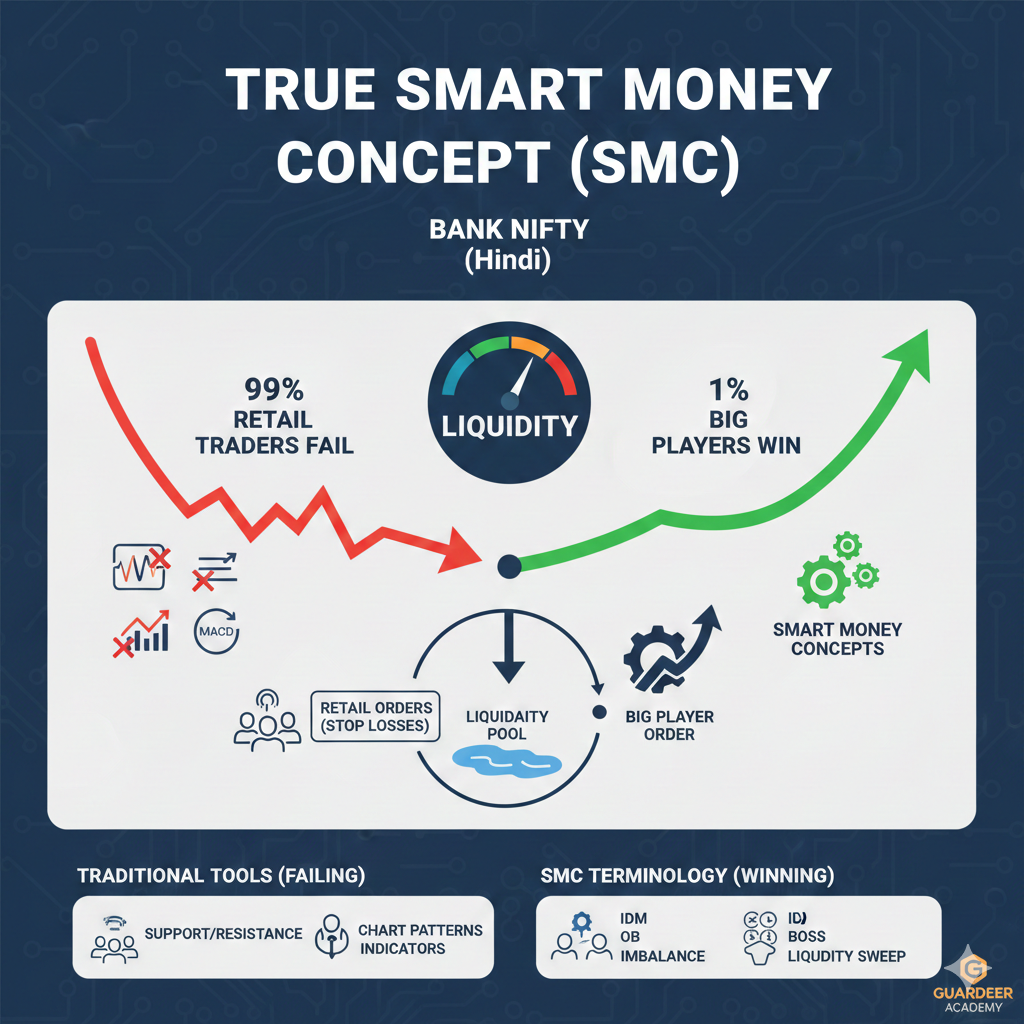
This foundational lecture serves as an introduction to a comprehensive, free course on the Smart Money Concept (SMC) in Hindi, with a specific focus on trading instruments like Bank Nifty. The core premise challenges conventional trading wisdom, arguing that it leads 99% of retail traders to consistent failure. The solution presented is mastering SMC—the only strategy that allows traders to operate alongside the powerful “Big Players.”
The Failure of Conventional Trading: Why Support, Resistance, and Indicators Don’t Work
The core argument begins by confronting the harsh reality: data shows that 99% of traders fail despite using common, widely taught methods. This advanced trading philosophy maintains that the strategies taught to most retail traders are inherently flawed because they are easily tracked and exploited by large institutional players.
The conventional tools that often lead to failure include:
-
Chart Patterns: W-Pattern, Head & Shoulders, Triangles.
-
Candlestick Patterns: Pin Bar, Inside Bar, Hammer.
-
Technical Indicators: EMA, MACD, and RSI.
-
General Price Action: Support, Resistance, and Trendlines.
The lecturer illustrates this with an example using the W-Pattern: while retail guidance suggests entering on a neckline breakout, the actual institutional buying occurs at a manipulated, deeper low. This makes the neckline entry a classic retail trap. It is asserted that these common patterns only work occasionally to maintain just enough retail trust to keep them trading and susceptible to manipulation.
Understanding the Big Players: The Trillions of Dollars in the Market
A key element of the SMC philosophy is the recognition of who truly controls the market. Daily trades in the Indian market involve trillions of dollars, not mere thousands or lakhs.
The Big Players who control this massive capital flow include:
-
Banks and Financial Institutions
-
Hedge Funds
-
FIIs (Foreign Institutional Investors)
-
DIIs (Domestic Institutional Investors)
The logical question arises: Do these entities risk billions of dollars based on a simple Support/Resistance line or a standard indicator? The answer, from the Smart Money perspective, is unequivocally no. They operate using methods that ensure superior entry and exit points.
Liquidity: The Real Fuel of the Market
The course introduction defines Liquidity as the single most critical concept, describing it as the “fuel of the market.”
-
What is Liquidity? It is the collective mass of all buying and selling orders (e.g., stops, limit orders) placed by retail traders.
-
Why Big Players Need It: Institutional players place orders so large (sometimes reaching thousands of Crores) that they cannot be filled without a counterparty. They require the massive pool of retail orders (Liquidity) to execute their positions.
-
The Manipulation: Big Players deliberately create zones—often seen as sideways or consolidation markets—where retail traders place orders on both sides. The market is then engineered to move quickly to collect all these retail stop-losses (the Liquidity), which simultaneously fills the Big Players’ orders, causing a major directional move.
A crucial takeaway for any trader: If you do not know the location of liquidity, you yourself become the liquidity that the market is hunting.
Introducing the Smart Money Concept (SMC)
SMC is presented as the advanced knowledge necessary to track and trade with the Big Players’ flow, ensuring you are not part of the 99% that fail.
The speaker provides real-world examples, demonstrating the ability to repeatedly sell near the high and buy near the low of a price move by applying SMC principles. The entire SMC outlook involves viewing the price chart not as random candles and patterns, but as a map detailing the flow of institutional money and the active hunting of retail liquidity.
Key Terminology You Will Learn in the SMC Course
The complete SMC course is designed to fundamentally change the viewer’s market perspective. Subsequent lectures will introduce essential SMC vocabulary, which is distinct from conventional trading terms:
| SMC Terminology | Concept |
| IDM | Inducement/Initial Deviation Move |
| OB | Order Block |
| Imbalance | Fair Value Gap (FVG) |
| BOSS | Break of Structure |
| PI | Point of Interest |
| CHOCH | Change of Character |
| SMT | Smart Money Technique |
| Order Flow | The directional pressure of institutional capital |
| Liquidity Sweep | The deliberate move to collect retail stop-losses |
The first official training module in the series will begin by defining and demonstrating the concept of Fractals.
Frequently Asked Questions (FAQs)
Q1: What is the Smart Money Concept (SMC)?
A: SMC is an advanced trading strategy that focuses on tracking the movements and intentions of large institutional traders (“Smart Money”). It moves beyond simple support/resistance to utilise concepts like liquidity, order blocks, and market structure to identify high-probability trade setups.
Q2: Why do most retail traders fail in the stock market?
A: According to the principles of SMC, most traders fail because they use common strategies (like chart patterns and indicators) that Big Players actively manipulate. These manipulations are designed to harvest retail stop losses, which provide the necessary liquidity for institutional entries.
Q3: What is ‘Liquidity’ in SMC trading?
A: Liquidity is the concentration of pending buy and sell orders, particularly stop-loss orders, placed by retail traders. Big Players use targeted price movements to “sweep” this liquidity, filling their own large-volume trades in the process, making it the essential “fuel” for market movement.
Q4: What specific topics are covered in the free SMC course?
A: The comprehensive course will cover critical SMC concepts, including Inducement (IDM), Order Blocks (OB), Imbalance (FVG), Break of Structure (BOSS), Order Flow, and Liquidity Sweeps. The initial learning module focuses on the structure of Fractals.